

On April 8th, 2024, a total solar eclipse will sweep across North America, from Mexico to the Maine-Canadian border. For those who experienced the spectacular solar eclipse of 2017, this one will be similar, crossing the United States from west to east and passing...
Have you ever wondered how people develop Alzheimer’s disease? Is it something that begins before the person or anyone else around them fully realizes that someone’s memory lapses are actually a symptom of something bigger? Is it all at the mercy of our genes, or can we take actions that lower the chances, or better yet, prevent the disease from occurring altogether? Finally, if a close family member or friend is diagnosed, what can we do to help alleviate the symptoms and slow down the pace of the illness?
Here, as someone who cares deeply about this subject, I’ve laid out information as well as links to informative Alzheimer’s awareness sites to address these really important questions. I hope I can help diminish the fear of the unknown by sharing the causes, preventative measures, and therapeutic interventions currently in place for this illness.
First of all, it’s important to remember that Alzheimer’s disease, as with most diseases, progresses differently in each patient, and it is impossible to precisely predict the path of the illness in any particular individual. In some instances, individuals have been known to live past their expected life spans and function relatively well with Alzheimer’s disease for many years. Accordingly, Alzheimer’s diagnosis is not an immediate death sentence, but rather an important clue on how to best move forward.
So, how does Alzheimer’s disease come about?
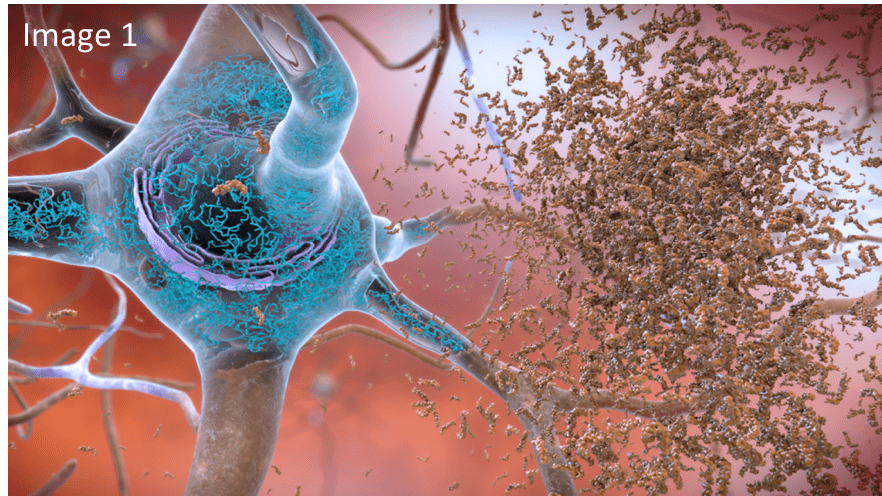
In the earliest stage of Alzheimer’s, abnormal clumps of proteins called plaques and tangles develop in the brain areas involved in learning and memory as well as decision-making and planning. Plaques are aberrant clusters made of of proteins called beta-amyloids, which build up between nerve cells in the brain (Image 1, plaques in brown). Plaques make it harder for adjacent neurons to communicate with one another. On the other hand, tangles form when a protein called tau twists on itself within brain cells (Image 2, tangles in dark green). Tau typically helps deliver key materials to different parts of the neuron by coating the roadways (or microtubules) 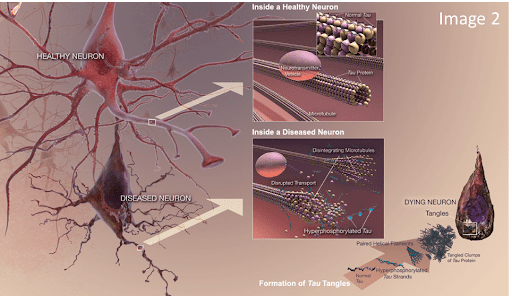 that run to and from the center of the neuron. These highways typically facilitate the transport of key nutrients down each extension of the cell, but when tau proteins become twisted, they can no longer coat the roadways, causing the roads to degrade. Without these inner cellular highways in place, nutrients and essential supplies no longer get transported from one end of the neuron to the other, causing neurons to stop functioning normally.
During the onset of Alzheimer’s, plaques and tangles begin to accumulate in small, restricted regions of the brain. Intriguingly, individuals at this stage do not exhibit any detectable behavioral symptoms of the illness and their primary care physicians don’t realize that there’s a problem. In fact, a person can have tangles and plaques present in their brain for decades without showing any signs of memory loss.
As the disease progresses, however, these plaques and tangles increase in number and begin to accumulate in larger regions of the brain. At this point, Alzheimer’s progresses through three stages in total: early, mild to moderate, and severe. Every stage progresses differently in each patient, but overall, the first stage can last decades, mild to moderate can last approximately 2-10 years, and the severe stage may last for about 1-5 years. While early-stage patients show little or no behavioral symptoms, patients show more obvious memory and cognitive function lapses as the illness progresses to the mild stage. The Alzheimer’s Association provides a very informative and easy-to-understand slideshow on their website that highlights the causes and progression of the illness through all three stages.
Is Alzheimer’s genetic – predestined regardless of our efforts to live a healthy life?
Approximately 75% of all Alzheimer’s disease patients have no family history of the illness, highlighting our lack of knowledge on the particular genetic causes underlying the illness in the overwhelming majority of cases. But the remaining 25% of cases can be subdivided into groups based on what genes are involved, with each gene giving people a different probability of developing the disease.
One type of Alzheimer’s disease has a known, direct genetic cause: early-onset familial Alzheimer’s disease, or early-onset FAD. This particular type causes individuals to start showing signs of mild to moderate Alzheimer’s between the ages of 30 and 60 years.
Now that we know that two-thirds of cases occur without any known genetic cause, what can we do to reduce our chances of developing Alzheimer’s disease?
 Thankfully, there’s a lot we can do to keep Alzheimer’s at bay. We can exercise regularly, maintain a healthy diet rich in fruits and vegetables, and abstain from smoking to maintain a healthy cardiovascular system. This ensures that our body will deliver nutrients to the brain through the blood system efficiently. In fact, staying physically active and eating well decrease the risk of developing conditions associated with Alzheimer’s disease, such as heart attacks and strokes; diabetes; obesity; and high blood pressure. People can also participate in lifelong learning activities such as practicing hobbies, reading, or enrolling in continuing education classes. It also helps to remain mentally active by performing activities that involve a lot of thought, such as crossword puzzles and sudoku. Finally, people can also protect their brains by maintaining an active and healthy social life.
If none of these efforts work and a doctor diagnoses you or a close family member with Alzheimer’s, what can you do to help alleviate the symptoms, slow down the pace of the illness, and enjoy an optimal outcome?
Currently there is no known cure for Alzheimer’s disease; however, scientists have developed drug treatments that can improve patients’ quality-of-life. Doctors can, for instance, manage their patients’ secondary conditions and/or symptoms of their associated conditions through drug intervention. Doctors can also help their patients enroll in enrichment activities and daycare programs, and get them involved in support groups and services. One class of drugs works well in some patients – cholinesterase inhibitors. These inhibitors, which keep brain cells active, can delay the onset of speaking, memory, and behavioral deficits during different stages of the illness. There are no drugs, however, that target the core genetic and molecular components of the illness. Extensive research efforts are ongoing as scientists work hard to develop treatments that target the disease. In addition, an effective physician will help their patient and his or her family develop a long-term plan for quality-of-life care for when the disease progresses into later stages to ensure that they and their loved ones can live in a safe and comfortable environment for as long as possible.
To learn more about the known genetic causes of Alzheimer’s, please visit the NIH National Institute on Aging, Alzheimer’s disease genetics fact sheet: https://www.nia.nih.gov/health/alzheimers-disease-genetics-fact-sheet.
To become more active in your local Alzheimer’s disease community, please visit Alzheimer’s Association, local chapter search page: https://www.alz.org/local_resources/find_your_local_chapter.
To learn more about medications approved by the FDA for the treatment of Alzheimer’s disease, please visit the National Institutes of Health, Alzheimer’s disease information page: https://www.ninds.nih.gov/Disorders/All-Disorders/Alzheimers-Disease-Information-Page.